
It was 2022 and I was watching Ultimate Frisbee…
Okay, I’m joking, I was watching Hayden Wesneski throw a wicked sweeper that started in the zone and as it moved toward the plate, seemed like it was going to land in the opposing dugout. I immediately thought — this guy is going to be really good.
It reminded me a bit of Sergio Romo from back when the Giants put together a dynasty of misfit toys. The frisbee like break. The way hitters wanted nothing to do with it. Sitting at 17inch horizontal break, it wasn’t the most movement on the pitch in the majors but the eye test said Wesneski had an out pitch that would be used for years to come. Unfortunately, this did not exactly come to fruition as I had thought. He proceeded to go back and forth between being a starter and a reliever, posting a 4.01 ERA in 222 innings through 2025. FIP and xERA are even a little higher. Not terrible, but not great numbers either.
This memory relit a fire and frustration I have had before when trying to identify pitching prospects for dynasty leagues in the past It reminded me how difficult it has become to create accurate predictions for pitchers at any age. Some with great stuff fizzle out, some with below average stuff stay in the big leagues for years. I’m not going to try to break down every metric invented to create a perfect number we can assign to a player — but this begs the question, what’s the difference between a pitcher with great stuff and a pitcher with great stuff that knows how to use it?
People Lie. Numbers Lie — Sometimes.
For some guys, like Paul Skenes, for example, it almost seems like it comes easy. The stuff is there and the numbers just naturally follow. For others like Sonny Gray, the stuff isn’t going to blow batters away and yet the numbers don’t seem to care. After a rough season in 2016 and 2018 where he was sitting in the 5 ERA range, Gray adjusted. Since then, Gray has posted a 3.50 ERA with a 3.33 FIP over 1061.1 innings. That’s a pitcher who figured out how to paint.
Then you have guys like Camilo Doval, who really personify this issue. With some of the nastiest stuff in the game, he was expected to be a long-term shutdown closer after a few good seasons in San Francisco. Unfortunately, he couldn’t seem to stay consistent enough for the numbers to match the quality of the stuff. He walked too many batters, leaned too much on his raw stuff and let the moment of the situation get to him at times. This got him a one-way ticket to New York where we are seeing more of the same. His baseball savant page still has plenty of red, so what does that say about him as a pitcher?
Pretty much everyone judges a pitcher on their ERA first. Then comes FIP. Then xERA. Then Stuff+. All of which are doing their best at providing enough context to project into the future, but as you move down the list each metric seems to reveal something new while also forgetting something that is still relevant. While FIP does a great job of showing what was expected of an individual pitcher by excluding what happens after the ball is hit into the field (most of the time), it completely ignores the fact that there will always be another eight players on the field, fans in the stand, and something unexplained in the air whenever a baseball game starts.
That context will always matter and the way a pitcher pitches in each situation says a lot about the quality of their game. The point isn’t that the stats are wrong, but the metrics tell you what a pitcher has done. Not necessarily the context in which it was done. They definitely don’t tell you what a pitcher will do and how they will adjust when things change.
“Velocity will get you drafted but it’s not going to help once you are drafted. You have to learn how to pitch.”
– Greg Maddux
Sometimes the stats align with the outcome and sometimes they don’t, just like the eye test. The real tell is being able to watch a pitcher and see if he knows how to play chess. Can he evolve as his stuff evolves? Zack Greinke, Justin Verlander, Max Scherzer, and Greg Maddux were great at this. Greinke revived the eephus in modern baseball. A snail of a pitch, not thrown for its “stuff” but a stroke of art designed to throw hitters off balance. Let’s actually take a moment to admire this artistic stroke of a pitch that freezes Trent Grisham in his tracks.
Greinke isn’t the only one either. Justin Verlander and Max Scherzer went from relying on blowing a fastball by hitters 60% of the time to painting a picture in the zone with five different pitches and looks.
Greg Maddux, who some say is the greatest pitcher of all time, doesn’t even crack the top 20 in strikeout rate among Hall of Famers. And while he was a master of command, he doesn’t crack the top 10 in walk rate either — meaning even the metrics that are supposed to capture his greatness don’t fully explain it. What he really was, is the master of baseball chess. Knowing what and when to throw a certain pitch was his superpower. This is the unquantifiable version of the game that makes projection so tough.
Pitching is Physics. Until it’s Understood.
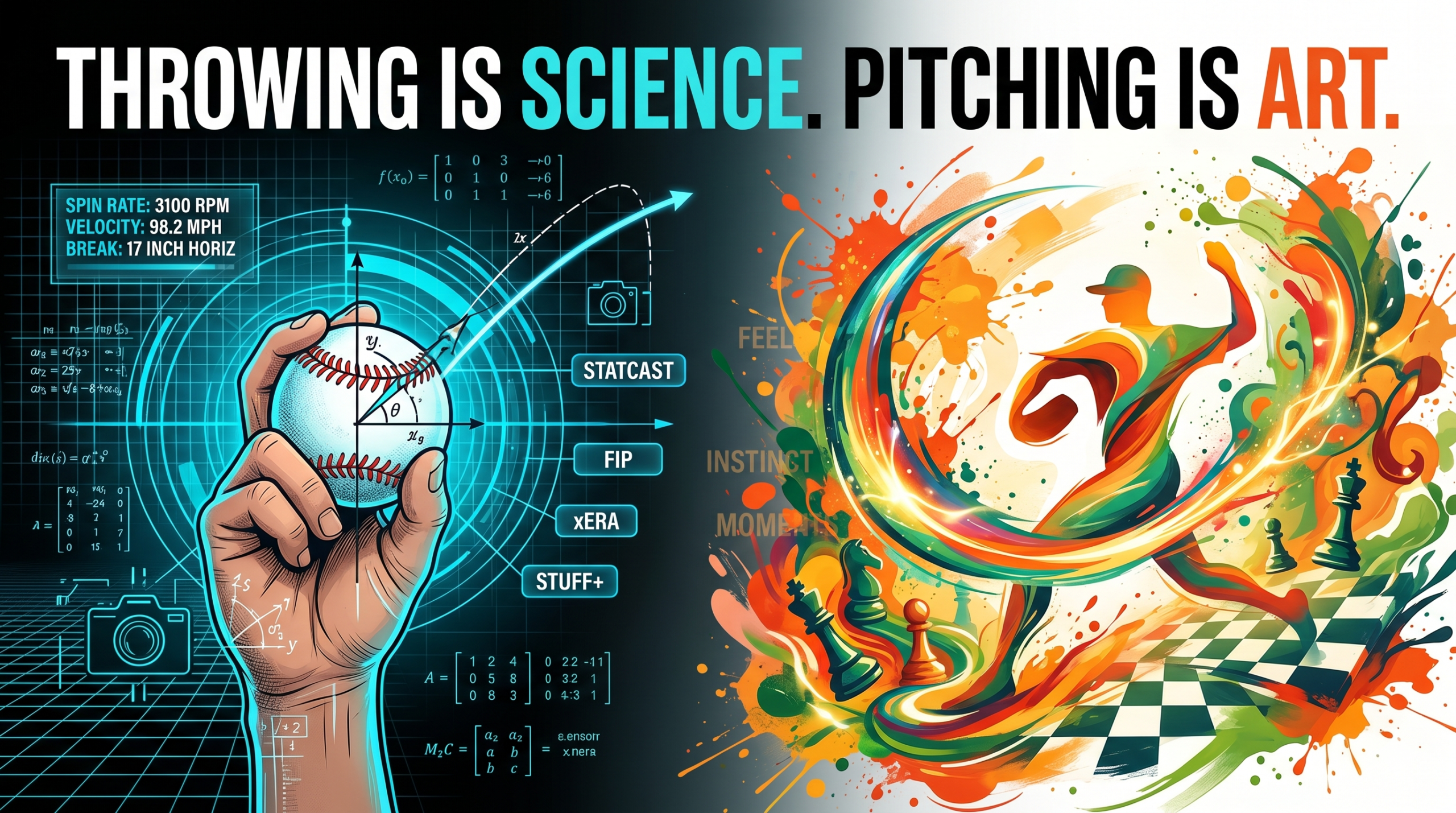
With all the different metrics and camera tracking, the modern game makes it seem like pitching is 100% a science, and in a very literal sense, it is. Spin rate, the wind resistance on the seams, the velocity and angle at which a ball is released are all very important when analyzing a ball being thrown. In reality though, there is a part of pitching that requires an artistic perspective. A feeling. A chess move nobody saw coming.
And this is why it can be so hard to figure out if a pitching prospect is going to be a legitimate asset in the big leagues. It takes time to understand the moves that are needed in order to win the game, even if history shows something different. Just because a slider has a 50% whiff rate does not mean you can throw it seven times in a row and expect to be successful. That whiff rate is missing the context of what the score of the game is, how the hitter is feeling, if he had just made an error in the field, or just happen to have some bad sushi the night before.
Modern baseball has never had more data on pitching. Statcast can reconstruct the physics of any pitch thrown in the last decade and yet pitching development still fails constantly. Prospects with elite stuff burn bright and then burn out. Journeymen with average stuff stick around for years longer than everyone expects. The physics are quantifiable. The artistry — knowing when to throw a pitch the hitter least expects, even if it isn’t your best pitch that day — is what turns a guy who throws a baseball into a pitcher.
One thing that has never changed is that baseball is a moments sport. Like Buster Posey, the front office executive said, “We are in the moments-making business”. Knowing what the moment calls for is what sets apart the burn outs from the burn brights. Like, the title says, throwing is science. Pitching is art.
Eephus
Now, I don’t have the answer (or metric) that can quantify the awareness necessary to be a Greg Maddux. I’m not 100% anyone does, except maybe Maddux himself. The metrics matter. The eye test matters, too, but you aren’t always watching for velocity or movement — you’re watching for whether a pitcher can paint a picture the hitter doesn’t understand yet. And until there’s a statcast metric for “reads the situation and adapts”, everyone will keep using a combination of imperfect numbers and imperfect eyes — but maybe that’s why it’s impossible to not be romantic about baseball.





Leave a Reply