
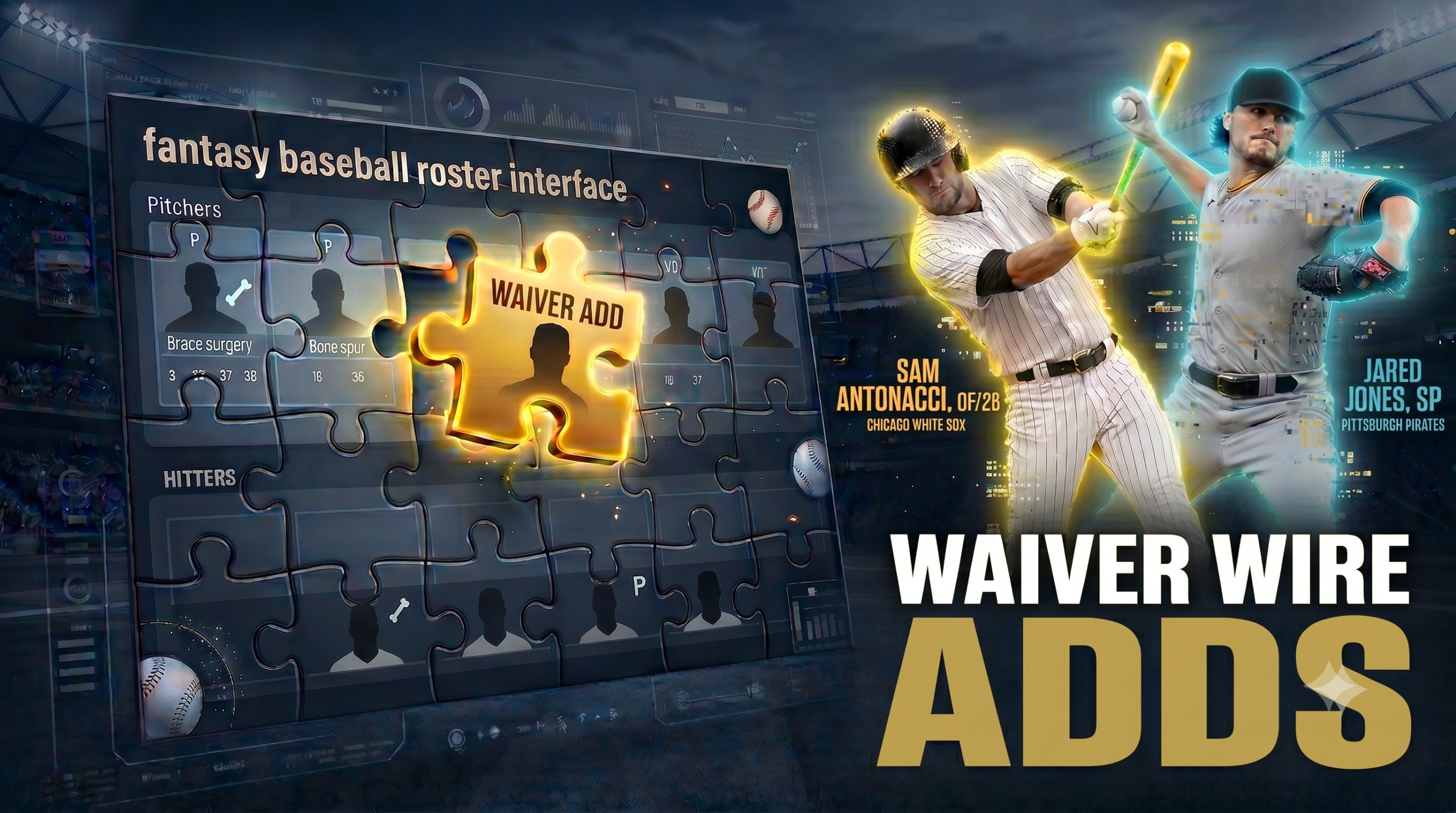
We are a quarter of the way through the MLB season, and it seems injuries have claimed a quarter of the league already. Managers need to fill gaps and find ways to make up for their lost assets. The problem is you can’t replace Giambi, but you may be able to recreate him in the aggregate. So, here are some waiver wire adds under 45% rostered to consider while looking to build the puzzle that is a fantasy baseball roster.
Waiver Wire Adds: Pitchers
Bryce Miller, SP — Seattle Mariners (37% Rostered)
The 2025 version of Miller was almost not worth rostering. He posted a 5.68 ERA but this was all while dealing with bone spur issues throughout the year. In 2024, it was a completely different story as he posted a 2.94 ERA with 171 Ks in 180.1 innings. His xERA for that season sits at 3.68, so I would go as far to say that a sub-3.00 ERA is what should be expected from him but he is back from injury and has the potential to greatly contribute to any team that may have drafted Tarik Skubal or Garrett Crochet.
His first start of the season concluded with 5.1 innings of 2-run ball and 3 Ks. He did give up a homerun and a walk, but you can’t ask for more than a 3.38 ERA with all the pitching injuries going around. One thing to keep in mind — the Mariners are in a spot where they can run a six-man rotation or mix and match as they see fit. This could chip into some of the innings that would have been previously allocated to Miller or Castillo for example.
Jared Jones, SP – Pittsburgh Pirates (37% Rostered)
Jones was a nice surprise in 2024. After his debut in March, he continued to form a formidable one-two punch with Cy Young candidate Paul Skenes — posting a 4.14 ERA with 132 strikeouts in his first 121.2 innings. Unfortunately, in spring 2025, Jones had to be shut down with elbow issues. In May, he underwent internal brace surgery, but is now on rehab assignment and should soon return to the Pirates rotation. In four starts for Triple-A Indianapolis, Jones has thrown 14 innings to the tune of a 1.88 ERA and 18 strikeouts. His FIP during those starts sits at 1.79, so he looks ready to contribute to both the Pirates and your fantasy team. Go pick him up if still available. Especially if you are in need of strikeouts.
Trevor McDonald, SP — San Francisco Giants (17% Rostered)
A sinker baller with an elite groundball rate, Trevor McDonald is starting to make an impact on a Giants roster that desperately needs starting pitching help. He doesn’t have the best stuff in baseball — a Stuff+ of 100 so far, but he has been able to go out there and throw strikes, miss barrels, and induce ground balls. This can work well with a decent defense behind you. He currently sits in the 97th percentile for BB%, 73rd in Barrel% and 99th percentile for GB%. That is good enough for McDonald to post a 2.37 ERA with 17 strikeouts in 19 innings of work. His expected and independent stats show a bit of regression is possible — xERA of 3.79 and FIP of 3.48 — but those are more than serviceable numbers from a free pickup off waivers. McDonald’s biggest issue is that Logan Webb will inevitably be activated off the injured list and the Giants have made some questionable moves with their younger players — calling up Bryce Eldridge just to have him as a bench piece — thus far in the season. So, even if McDonald is probably the best fit to fill that 5th rotation spot, there is a good chance he will spend more time in Triple-A this season. In deeper leagues, or if you need to bridge the gap until Logan Webb returns, McDonald can be a great flier.
Christian Scott, SP — New York Mets (17% Rostered)
Scott had some sneaky prospect pedigree a couple of years ago as he was striking out 30 percent or more of the batters he faced while moving up the minor league ranks. He then had to undergo Tommy John surgery in Sept. 2024. He still has decent strikeout potential — Stuff+ sits at 106 — and gets good extension off the mound at 6 foot 4 inches. So, there is some deception to his profile, but the main story here is the Mets rotation. Clay Holmes, Tylor Megill, and Kodai Senga all struggling with injuries presents an opportunity for Scott. He should get plenty of leash to be a contributor for the foreseeable future but is not someone who is going to anchor a rotation. He has yet to give up three or more runs in a start to date, but has also not pitched more than five innings in any start either. This could be more about managing the workload coming off surgery but if he is able to settle in and produce anywhere near where his minor league numbers suggest he could be capable of, Scott is worth a look in 12-team leagues or deeper.
Aaron Ashby, RP — Milwaukee Brewers (42% Rostered)
Ashby is one of my favorites on this list. While he has the highest rostered percentage of the players mentioned, it should be much higher. Especially with as many pitching injuries as there are early into the year. Ashby, a former starter turned middle reliever, has posted an ERA under 2.90 and a K/9 in the double digits for the last three years. A lot of his success has to do with the huge whiff rates he gets on his breaking and offspeed pitches — changeup, slider, and curveball all run whiff rates between 30%-50% . This year is more of the same as he has pitched 29 innings and struck out 44 producing a 2.17 ERA. He has great stuff — Stuff+ of 122 supported by a whiff rate of 50%-70% on the aforementioned pitches — and consistently comes into the game for a couple innings at a time. Middle relievers tend to be overlooked in fantasy baseball, but when you are missing a starter or two, an elite middle reliever with two or three appearances in a week can be just as valuable as a top notch starter. For example, from May 6th to May 13th, Ashby posted 6 innings in relief with 9 strikeouts, and 0 earned runs. And, if you are in a league that still uses runs, he also posted 2 W’s in that time as well. Those are elite numbers from any starting pitcher, with the added benefit of an extra win. If you can fit him into your roster game plan, do it.
Waiver Wire Adds: Hitters
Cam Smith, OF — Houston Astros (14% Rostered)
Smith is the buy-low breakout candidate in this article. Smith is intriguing because of his power and speed combination. His bat speed is sitting at 77.4 MPH, good enough for 5th fastest in baseball and his sprint speed is faster than 94 percent of the league as well. Here is what piqued my interest though — his barrel rate has jumped from 6.9 percent to 13.3 percent, over double the rate of 2025. What’s more impressive is that he is doing this while also increasing his bat speed by almost 3 mph since last year. So, why is he only hitting .199/.294/.314?
Part of that is luck. He has a career low .265 BABIP, signaling there may be some positive regression here. The bigger thing to keep an eye out for — and is a contributing factor to his low BABIP — is his ground ball rate, which sits at 43 percent as well as his attack angle/timing. A lot of this has to do with his batting stance location. Smith is sitting further back in the batter’s box and slightly further away from the plate this year, which has moved his attack angle from 8 degrees to 11 degrees. He has more time to bring his swing through the zone. This explains the 5 percent increase in fly balls. The good news is that the stance change is already working — his groundball rate is trending down from last year. The only issue is the direction he is hitting the ball. Those fly balls are going to center field rather than his pull side, where slugging percentages on fly balls are about 250 points higher for most hitters. Compared to last year, the rate at which he pulls the ball in the air is actually three percent lower. Once Smith can pull the ball in the air consistently while keeping his improved attack angle, his production could skyrocket.
Sam Antonacci, OF/2B — Chicago White Sox (16%)
Antonacci has snuck under the radar, but the numbers are starting to make that harder to justify. Through 112 plate appearances he’s slashing .298/.391/.426 with a home run and three stolen bases — and the underlying Statcast data suggests even that undersells him. His xBA, xSLG, sweet-spot rate, chase rate, and strikeout rate all sit in the 90th percentile or better. He’s currently trailing only Yordan Alvarez in expected batting average. At 16 percent owned, that is quite the disconnect.
On top of that, while he isn’t a burner by nature — his sprint speed is faster than 77% of the league — he swiped 48 bags in 116 minor league games last year. With that, his only downfall may be his hard-hit rate, which sits at 36 percent or only in the 23rd percentile, but that is still very serviceable in an age where the league batting average tends to sit in the .240 range. If he can continue this production, you may be looking at the American League version of Luis Arraez.
Ryan Waldschmidt, OF — Arizona Diamondbacks (14%)
If you caught our dynasty piece two weeks ago, Waldschmidt was the centerpiece in a long-term trade. Here we are already looking at him as an everyday player after the D-Backs decided to move on from Alek Thomas. The profile here is that of a five-category contributor. While he may not hit 40 homeruns in a single season, Waldschmidt seems primed as a perennial 20-20 guy. His 2025 minor league line goes like this: .289/.400/.477, with 18 homeruns and 29 stolen bases in 134 games.
And now, after going 3-3 with two doubles, in Monday’s game against the Giants, he is sitting at a .313/.371/.438 slash line to start his MLB career. Although he has not yet qualified, his early Statcast data supports this as well with a xBA of .284 and chase rate in the upper 90s percentile already. In deeper leagues, especially keeper and dynasty, he should be a depth add in the event he is able to continue to translate his tools into major league success.
Austin Martin, OF/2B — Minnesota Twins (7%)
Martin is sort of a poor man’s Antonacci. He doesn’t run as fast, doesn’t hit the ball as hard, but his plate discipline is better than almost anyone in baseball. He currently has a chase rate of 16.4 percent which is good enough to be better than 99 percent of the league. Here is where he has the edge on Antonacci. That eye at the plate is resulting in a 15.8 percent walk-rate. So, while Martin only has one homerun — which has been true the last three years, so don’t expect much in the power department — his OPS is currently sitting at .811. That’s higher than Jose Ramirez. Now, is that really a sustainable number? Probably not, but to give Martin the benefit of the doubt he did also walk at above a 12 percent clip last year, so he can be of use in OBP leagues at a time where the second base position is a bit shallow.
The cherry on top is that he will contribute a few stolen bases here and there. He already has seven on the year. Martin is obviously not Jose Ramirez but with the amount of injuries circulating, he is a guy that contributes in a category or two depending on the league you are in.
Anthony Volpe, SS — New York Yankees (8%)
This may be the hottest take of the article depending on who you talk to, but Volpe is not that far removed from a 20-20 season. Let’s not forget he almost did it again last season while dealing with a labrum injury. He still has consistency issues at the plate, but there is a window of opportunity for him to prove worthy of the starting shortstop gig in the Bronx right now. He’s such an interesting case because he has the middling ability to barrel the ball — 64th percentile in 2025 — and the ability to lay off pitches outside the zone — 75th percentile in 2025 — but he just can’t seem to bring the bat around fast enough to consistently increase his odds of a batted ball falling for a hit, that is, unless he hits it over the fence. His bat speed in 2025 sat at 72.6 mph which is quicker than 59 percent of the league, another middling metric for Volpe. Then while his chase rate is above average, his strikeout rate is among the bottom 30 percent in the league.
So, while you will have to deal with the fact that Volpe is most likely going to strikeout once a game, when he does barrel a ball up it very well could go out. Throw a few stolen bases in there and you again have somebody who can contribute in a couple categories. In 20 plate appearances since rejoining the Yankees he has hit .308/.550/.462 with no homeruns and two stolen bases. So, for those that built their shortstop position around the likes of Francisco Lindor and Corey Seager, Volpe could offer a sliver of hope in the meantime.
Miguel Andujar, 3B/OF — San Diego Padres (5% Rostered)
Andujar has been surprisingly productive over the past few years hitting .301/.333/.439 with 18 homeruns and five stolen bases since 2024. You won’t be getting much in terms of steals, but let’s not forget he did hit 27 homeruns back in 2018 with the Yankees. He is also playing almost everyday for the time being. Since the start of May, he has hit .281 with three homeruns, serviceable in plenty of deep leagues. Andujar looks like he still has enough gas in the tank to provide a solid batting average and still hit one out every now and then. He’s currently the most consistent hitter on the Padres, so take advantage while it lasts if you are looking for a depth piece
Injuries and Prospects Watch list
Alejandro Kirk, C — Toronto Blue Jays (26% rostered) — Kirk has not been cleared to take full BP yet, but he was one of the better hitting catchers in the game last year. So, with Drake Baldwin going down among others, this could be an early bird gets the worm scenario if all works out.
Heliot Ramos, OF — San Francisco Giants (42% rostered) — Ramos was just placed on the injured list and is now owned in 42 percent of leagues. This is a classic buy the injury dip situation if you have an extra spot open on the roster. Ramos has been good not great, but if you need 20+ homerun pop, he could contribute once he returns from the injured list.
Lars Nootbaar, OF — St. Louis Cardinals (1% rostered) — Another good not great candidate that will be available in deeper leagues. Nootbaar just started his rehab assignment after undergoing heel surgery in the offseason and already has a homerun to his name. While nothing special, he has posted decent OPS numbers due to his walk-rate and consistent homerun numbers of the past four years. He can even steal a base here and there — although, I wouldn’t count as much on that after heel surgery.
Jesus Made, SS — Milwaukee Brewers (8% rostered) — Honestly, Made is probably not experienced enough to warrant an add in shallower leagues, but if you have an NA slot available there is an outside chance the five-tool prospect sees the big leagues in the second half. Through 37 games in Double-A, he has posted a .265/.343/.445 slash line with five homeruns and 17 stolen bases. In keeper and dynasty leagues he should already be on your roster and considered at least a top five prospect.
Cooper Pratt, SS — Milwaukee Brewers (1% rostered) — Speaking of Made, this is the guy that may prevent Made from seeing too much time in the majors during 2026. The Brewers signed Pratt to an 8-year, $50.75 million contract through 2033. He is currently in Triple-A hitting only .234 — that is with four homeruns and 11 stolen bases — but is walking more than he is striking out, while sitting at a .252 BABIP. Looks like a small bit of refinement or regression will have the 21-year old join the big-league club soon enough.
Ralphy Velazquez, 1B — Cleveland Guardians (1% rostered) — Velazquez was just called up to Triple-A by Cleveland, so he is now on the watch list for major league action at some point this season. The power-hitting lefty blasted 22 homeruns over 122 minor league games last season and already has seven in 36 games this season. The Guardians are currently deploying Kyle Manzardo, who to date, is hitting homeruns at half the rate he did in 2025, when he sent 27 over the fence for souvenirs. There could be more opportunity for Velazquez here than originally thought headed into 2026.
The Trade-Off
When it comes to the waiver wire, the player you add is only half the decision. The one you drop is the other half (most of the time) — and it’s just as important. Before you add anyone on this list, remind yourself of the roster you built, what it needs to win this week, and what it needs to contend in August. The best waiver wire managers aren’t just good at finding players. They’re good at knowing which ones to protect.
9th Inning
In fantasy baseball, draft season gets all the glory. Everyone spends months agonizing over who to take in what round, convinced that’s where championships are built. And maybe it is — but it’s the grind of the middle months that decides who actually lifts the trophy. Every week you overlook the breakout rookie or the veteran who quietly remade his swing is a week your roster falls behind and your league mates gain ground they didn’t earn. Don’t let them win for free. The wire doesn’t sleep. Neither should you.




Leave a Reply