
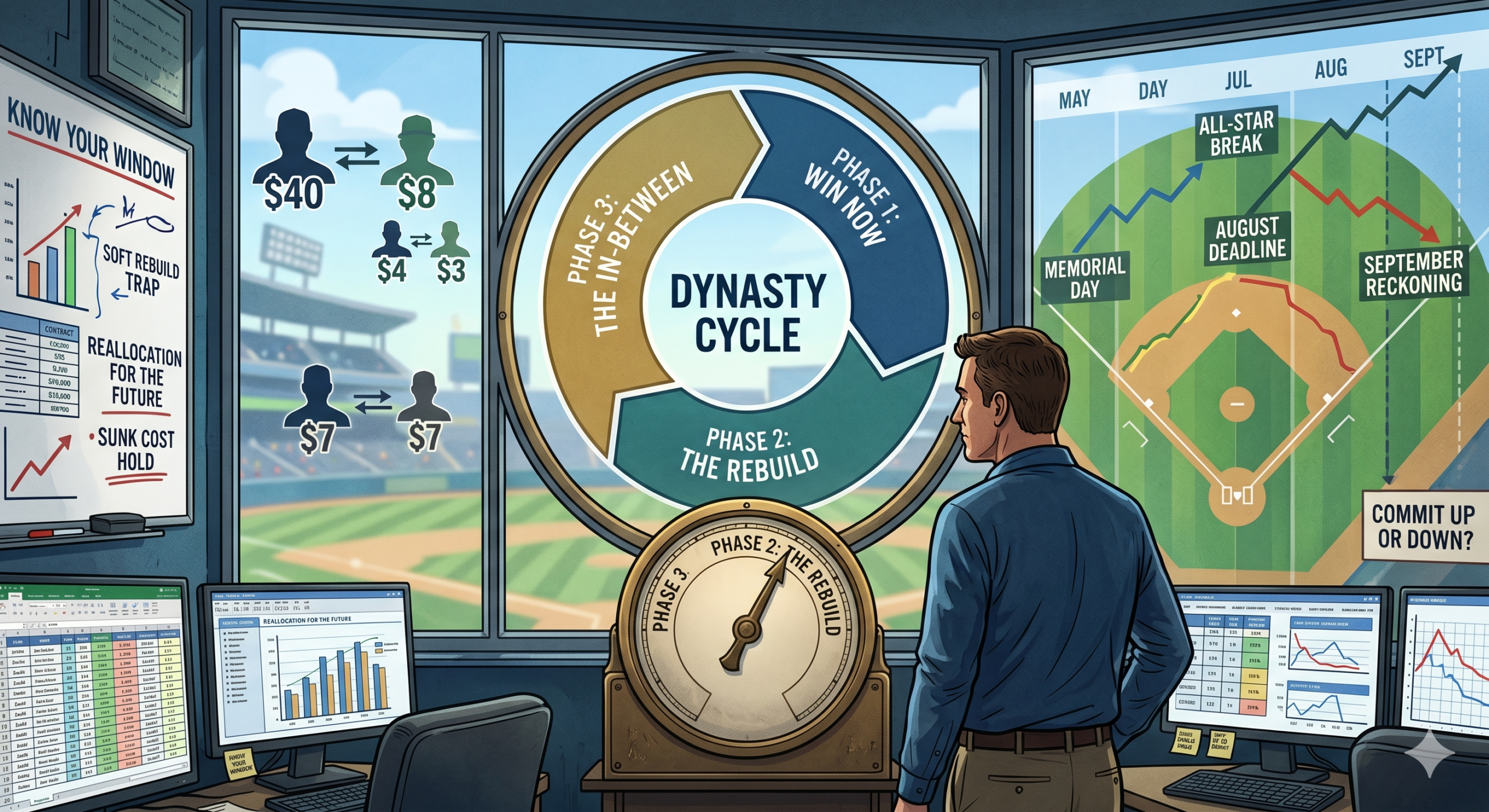
Understanding the dynasty fantasy baseball cycle is the difference between building a champion and spinning in circles for years.
Last week I traded Alex Bregman and Bryce Miller.
Not because I wanted to. Bregman is a former top-five third baseman in dynasty. Miller looked like he could be a foundational piece after his breakout 2024 season. These were players I had conviction in, and moving them felt like admitting something.
But that’s exactly the problem with dynasty — and exactly what this piece is about.
In return, I received Ryan Waldschmidt ($4), Jonah Tong ($3), and Gabriel Moreno ($7) in my Ottoneu league, where every dollar matters and a bloated salary can anchor a roster to the bottom of the standings for years. Bregman was costing me $40. Miller was $8. You do that math and suddenly the trade isn’t a surrender — it’s a reallocation for the future. Especially when you are sitting towards the bottom of the standings.
Knowing the difference between those two things is everything in dynasty. And it starts with one question most managers never honestly answer: Where are you in the dynasty cycle?
| Phase | How to identify it | Key move to make | Danger sign |
|---|---|---|---|
| 🟢 Win Now | Top-third standings, prime-age core, prospects you don’t need | Sell prospects for immediate impact — stop hoarding lottery tickets | Still in bottom half by All-Star Break despite veteran core |
| 🔴 Rebuilding | Expensive veterans underperforming, young depth is thin, salary bloated | Every trade must make you younger, cheaper, or more flexible — ideally all three | Half-rebuilding — one foot in present, one in future |
| 🟡 The In-Between | Middle of standings, 26–30 year old core, no clear separation from the pack | Pick a lane by the All-Star Break — commit up or commit down | Waiting and hoping things click — costs you two years minimum |
The Three Phases of a Dynasty Team
Every dynasty team — whether you’re in a 20-team standard dynasty league or a 12-team Ottoneu league with salary arbitration — cycles through three phases. The managers who succeed are the ones who can accurately identify which phase they’re in right now and make decisions accordingly. The ones who fail are usually the ones stuck between phases, telling themselves a story that the standings aren’t confirming.
Phase One: Win Now
You know you’re here when your young players suddenly seem to be in their prime. That 2021 first-round prospect you drafted is now 26, arbitration-eligible in real life, and contributing real value to your team daily. (Oneil Cruz and Jonathan Aranda come to mind in one of my other leagues). Your pitching staff has depth. Your lineup is settled. You’re contending for a title or at least sniffing the top third of the standings during the first half of the season.
The temptation in Win Now is to hold everything and freeze. You built this. You know what each piece cost you. Making any moves almost seems counterintuitive because you’ve already come this far.
But Win Now has a shelf life, and the best dynasty managers treat it like a business. Here’s what smart Win Now moves look like:
If you’re in the top half of standings: This is the time to be a seller of prospects you don’t need and a buyer of players with immediate impact. Your window is open. Stop hoarding lottery tickets and cash them in for guys who help you right now. That 19-year-old outfielder sitting in A-ball? He’s not helping you win this year’s title. Move him for a rental or a near-MLB arm that fills a real gap. Don’t forget how important Saves and Holds can be. A hype prospect that still has three years of development left can nab an elite relief asset in many situations. I have won championships with moves like that.
If you’re in the bottom half of standings but have a veteran core: Pay attention. You have until roughly the midpoint of the season — typically the all-star break — to see proof that this team is what you thought it was. If the standings aren’t moving by late June, you are no longer in Win Now. You’re just in denial. This is when you start to consider Phase Two.
Phase Two: The Rebuild
This is where I am.
A true rebuild isn’t a failure — it’s a strategy. But it requires honesty and, more importantly, it requires actually committing to it. Half-rebuilds are where dynasty teams and careers go to die. You can’t keep one foot in the present and one foot in the future. The market/league will exploit that indecision every time.
The Bregman and Miller trade is a case study in what a real rebuild move looks like.
Bregman at $40 in Ottoneu is a significant commitment. He’s a quality player — but quality players are only assets if they fit your timeline and cost. At $40, he was consuming 10% of my entire budget for a player whose best dynasty years are likely behind him. Yes, I’m retaining his salary, which immediately opens up options for next year’s auction and more importantly, gets the deal done. That retained salary becomes leverage. It becomes a trade chip. It becomes flexibility I didn’t have before…
One important detail is I have had Miguel Vargas sitting on the bench all year in favor of Bregman. Vargas is currently outperforming Bregman on a points per game basis when it comes to Fangraphs Points Scoring and he only costs me $3 right now. Talk about moneyball at its finest.
Miller at $8 is a bit harder to explain. I still believe in his talent. But here’s the thing about dynasty — belief without current production is just hope. His walk rate climbed and his strikeout rate dropped in 2025. Now he’s coming off an injury with real uncertainty. Even though he is almost 28, he could still return to what he was a couple years ago.
But remember, it is always better to move a player a year early, than a year late.
In a Win Now window, you hold Miller and pray he contributes once he is back in a few weeks. In a rebuild, you move him when someone still values the name and you can acquire top prospects at low cost.
This is where rebuild trades separate good dynasty managers from great ones.
Ryan Waldschmidt ($4) is the kind of prospect that can get overlooked because he doesn’t have one 80 grade tool, he has two or three that can really make an impact. He has had a walk rate above 10% every single year in the minors, legitimate power ability, and a hit tool that should at least keep him in the lineup. In Ottoneu, where a power and on-base skillset is very valuable (Check out the scoring system here if interested), Waldschmidt’s floor is really quite high for a $4 price tag. He doesn’t need to be a cornerstone — he needs to be a reliable contributor at an efficient cost, and that’s exactly what he profiles as.
Jonah Tong ($3) is the high risk, high reward piece of this return, and I want to be clear about that. These types of moves do involve risk. He’s struggling with his command in AAA right now. That’s a real concern. But the strikeout upside is loud enough that even a slightly improved walk rate gets him to a point where he’s a legitimate scoring contributor and potential foundational rotation piece. He has a path to the Mets rotation this year given their pitching situation. At $3, you’re buying the ceiling at clearance prices. In the stock market, you would call it buying the dip. That’s rebuild logic in a nutshell — accept the risk, buy the upside cheap, and let it ride.
Gabriel Moreno ($7) is the most immediately practical piece. I only had one catcher spot filled entering this trade (two catcher league), and Moreno used to have a good amount of pedigree for his hit tool before he was called up, so at $7 he can help fill the gap in points in the near term while being cost efficient. He might not stick on my roster next year depending on how his season goes. But right now, while my injured pitchers work back, Moreno gives me points in the lineup I didn’t have. That’s not game changing, but it keeps points on the board while I transition my team into a contender.
The bottom line on rebuilding: Every move you make should answer the question — am I getting younger, cheaper, and more flexible? If the answer is yes, you’re probably rebuilding correctly. If you’re making moves based on old brand names that cost too much (i.e. Bregman in this case), you’re not rebuilding and you better be in Win Now mode or you’re just losing slowly.
Phase Three: The In-Between
This is the most dangerous place to be in dynasty, and more managers live here than they’d probably admit.
The In-Between is when you’re not clearly contending and not clearly rebuilding. Your best players are 25-28 — good age, real talent — but you’re sitting in the middle of the standings, and nothing is separating you from the pack. You’ve got one elite OF, a couple of solid pitching pieces, but a lot of question marks.
The instinct here is to wait. See how things develop. Maybe things click, you might think.
That instinct will cost you years potentially. If you have, say, a Pete Alonso type player mixed in with a bunch of guys who are contributing but aren’t pushing you over the edge it may be time to move Alonso and depth for some elite prospects. And the same goes in reverse, If you’re sitting there with Alonso, Bobby Witt Jr., Tarik Skubal, and Mason Miller. That is prime for selling off some of the younger guys who are not in the MLB yet or are not yet contributing in a meaningful way.
The In-Between requires the most active management of any phase because you have to make a real decision: commit up or commit down. And the calendar is your guide.
The Calendar Piece: When Do You Pull the Trigger?
Here’s what most dynasty advice glosses over — timing matters just like in MLB, and it’s tied directly to the season schedule, just like in MLB.
Now through Memorial Day (early May through late May): This is still information-gathering and assessment time. There are still some small sample sizes trying to fool your value analysis of guys here and there. Most batters are sitting between 100 and 150 at-bats, most pitchers are sitting at 30-50 innings pitched. There is plenty of time for extremes to revert to the middle.
Find your trade targets. Don’t make dramatic moves based on what you’re seeing right now unless you’re confident in the direction of your roster and willing to commit up or down. While there is still noise in the numbers, this can also be the time to strike on some of your favorite prospects of the future — like my Bregman and Miller trade, I was able to grab a few cost efficient prospects with high ceilings and fill a gap on my immediate roster as well.
Memorial Day through the All-Star Break: This is your take-action window. By late June and early July, the standings are telling you something. Six to eight weeks of data has separated the contenders from the pretenders in most formats. If you entered the season thinking you were a Win Now team and you’re sitting in the bottom third of standings by the All-Star Break, the market is telling you something your ego doesn’t want to hear. It’s for a reason. Listen to it.
This is also the prime buying window for rebuilding teams. Contenders are on the edge of their seats. They’re more likely to overpay for short-term help. You are the long-term beneficiary here. Your veterans and cheap contributors are at peak value to a desperate team sitting two games out of a playoff spot. As a Win Now team this is also not a bad time to start thinking about moving prospects in favor of current contributors that can push you toward the championship game. Sometimes the early bird gets the worm.
Post All-Star Break through August: If you’re genuinely contending, this is when you have to go for it, if you haven’t started already. Add salary. Trade prospects. Mortgage a piece of the future if the window is real. Titles don’t come around every year. But if you’re not in it by August, you are officially in rebuild mode whether you’ve accepted it or not. The sooner you accept it, the better the return you’ll get on your veterans.
September onward: As a rebuilding team (or a team caught in the inbetween), Start thinking about next year. Every decision from here should be made with the offseason in mind — draft strategy, keepers, auction targets, salary retention choices, which prospects you’re rostering for the future.
The Psychology of the Tough Move
Let’s talk about the part not many write about.
Moving a player you drafted, “developed”, and believed in is genuinely difficult, even in fake baseball. It’s not just a spreadsheet exercise. Dynasty fantasy baseball creates real attachment — you scouted this guy in A-ball, maybe you took the heat from your league when you drafted him in the third round, and you’ve been defending him in group chats for two years. Moving him feels like admitting you were wrong.
You weren’t wrong. The game changed. He changed. Your team changed.
Things change.
The best dynasty managers learn to accept that change and adapt to it: they separate player quality from roster fit. Bregman is a good player. He was wrong for my roster at that price at this moment in my dynasty cycle. Those are two completely different statements, and confusing the two is how managers make decisions that cost them years of competitiveness.
Here are four mental traps that cost dynasty managers years of competitiveness:
The Sunk Cost Hold
“I gave up a lot to get this guy (or I draft him in the first round), so I can’t move him for less.” This is the most common mistake in dynasty and redraft leagues alike. What you paid is irrelevant. What matters is what he’s worth today and whether he fits where you’re going.
The Identity Trade
Moving the player you’re most known for in your league — the guy who defines your team — feels like losing an identity. It’s not. Your identity should be as a manager, not as the keeper of any one player. (After typing this, I realize probably should have traded Mookie in my 16-team league last year…I guess you live and learn)
The Soft Rebuild
You tell yourself you’re rebuilding, but you keep making moves that preserve your current situation because you aren’t in last place. Well, you aren’t in first either. True rebuilds require clearing salary, accepting short-term pain, and trusting a process that won’t pay off for 18-24 months.
The Panic Sell
The opposite error — seeing a bad April and blowing up a team that was actually still contending. This is why the calendar matters. Don’t make rebuild decisions in May unless the roster logic was already there. (Miguel Vargas better not let me down)
Trade Structures by Phase
Win Now, top half of standings: Buy impact, sell prospects. Target players that have proven themselves and are contributing in the middle of the order on good teams. Move your depth pieces and lower-ceiling prospects to get them if possible. There will be times you need to move the hype prospect for an elite star…do yourself a favor and just do it. You are competing for a title — act like it.
Win Now, bottom half of standings (approaching All-Star Break): This is your warning zone. Start shopping your veterans quietly. Gauge the market. If you can’t find a trade that makes your team legitimately better before the deadline, accept that your window may have closed and begin the transition. I like to target the 3rd – 5th place teams in this situation. They usually have prospects and have more incentive to move them to get into those top two spots.
Rebuilding: Every trade should make you younger, cheaper, or more flexible — ideally all three. Accept short-term point losses. Target the prospects of contending teams who are willing to overpay in youth for veteran production. Be the team that says yes when others say no.
The In-Between: Be brutally honest first. And trust, I’ve been there. Then pick a direction and commit to it. Half measures don’t work here. If the standings by late June tell you to rebuild, rebuild aggressively. If they tell you you’re closer than you think, buy. But pick a lane and start looking for opportunities.
Final Out
Dynasty fantasy baseball rewards patience, self-awareness, and the ability to accept short term pain for long term gain (cliché, I know). It’s the format that most closely mirrors the decisions a real front office has to deal with — balance the present and the future, manage a budget (in an auction keeper league), and make roster decisions that always involve some level of risk.
Make your moves accordingly. And when the time comes to make the tough call, trust the process more than you trust the name on the jersey. It won’t always work out perfectly, but that comes with the territory. Just be sure to know your window.
Have a dynasty question or a trade you’re wrestling with? Send it to info@thebaseballeffect.com and it might end up in the next War Room column.




Leave a Reply