Over the past few seasons Eddie Rosario has emerged as one of the more solidified power hitters in the major leagues and fantasy leagues alike. He has averaged 27 home runs over the past three years, with his career high of 32 coming just this past season. Not to mention, this was on a team that broke the season home run record (along with three other teams), so there is not going to be any shortage of power in Minnesota. Rosario will no doubt be a contributor of power in that lineup, but does his production warrant his current average draft position?
Rosario is currently being drafted at around the 90th overall pick according to both the NFBC and Fantasy Pros. Here are his stats from 2019.

More than 30 home runs? More than 100 rbi? Almost 100 runs? That’s quite the fantasy season, but let’s take into account league context. Fifty-eight players hit 30 or more home runs in 2019. Of those players, Rosario ranked 50th in terms of OPS. That has a lot to do with Rosario’s current walk rate but nevertheless this ranks behind guys like Carlos Santana and Rosario’s own teammate Max Kepler, both of whom happen to have an ADP of around 140. Since Kepler is on the same team lets take a look at his 2019 stats and compare value.
Later Round Value

A lot of similarities between the two outfielders. It’s almost like they are Twins. Kepler played three less games, yet he out performed Rosario by four home runs. On the flip side, Rosario hit in the heart of a dangerous line up and was able to drive in over 100 runs, some of those being Kepler. Over the course of a full season these differences are marginal at best but Kepler stands out when it comes to plate discipline. Rosario was 10% more aggressive at the plate than Kepler in 2019, ironically resulting in Kepler having an almost 10% advantage on Rosario in walk-rate. With the increase in OBP and OPS leagues, there is a case to be made that Kepler is the best outfielder to draft in Minnesota. His ADP is less expensive and he provides a way to indirectly invest in the power Rosario and Donaldson will provide in 2020.
Let’s get right into the next value pick, Carlos Santana. Here is Santana’s line for 2019.

Now, Santana played about 20 more games than Rosario and Kepler, so he may not hit quite as many home runs all things being equal. With that said, look at Santana’s walk-rate and strikeout-rate! Santana has always possessed superior plate discipline skills but he set a new career high in OBP in 2019. Keep in mind, this is not a skill that diminishes over time, like speed. Santana could very well repeat this performance, while potentially receiving a boost in a couple of categories if Francisco Lindor, Jose Ramirez and Franmil Reyes are able to stay on the field and contribute consistently. What’s impressive here is that Santana has both Rosario and Kepler beat in almost every rate statistic (BB%, K%, AVG, etc.). He also has the highest hard hit rate of the three at 43.3%, although Kepler is not far off at 42%, while Rosario finished at 39%. It’s now obvious that Rosario’s performance, currently, can be acquired at a discount, allowing owners to maybe move in on a increasingly scarce position like first base (Josh Bell ADP:93) or starting pitcher (Jose Berrios: 89, Corey Kluber:95).
Let’s take one more look at more of a pure power play that could produce numbers similar to Rosario. Franmil Reyes.

Taking a quick glance at Reyes’ power numbers will tell you most of what you need to know. His ISO is sitting at .263 for 2019, while Rosario is about .40 points below that, but there is always give and take. Reyes finished 2019 swinging at 59 percent of pitches thrown to him, while making contact 65 percent of the time. Rosario, on the other hand, was 8 percent more aggressive and made contact 15 percent more of the time. This is where Rosario starts to outperform Reyes. Rosario will most likely be able to keep his .270 plus batting average given how often he is able to put the ball in play, while Reyes will most likely continue to struggle a bit more with swinging strikes comparatively. The big difference here is ADP. Reyes will actually take more walks and is capable of hitting more home runs than Rosario, but his batting average will most likely stay at the .250 level. Either way, Reyes is being taken almost 60 picks after Rosario in NFBC drafts, while the only major difference here seems to be .20-.30 points of batting average. That’s only about 25 hits over the course of a season. With that said, It wouldn’t be too much of a surprise to see Reyes ranked higher than Rosario next year.
If Not Rosario, Then Who?
So, you need an outfielder, but don’t completely trust that Rosario is worth the value.
Enter Marcell Ozuna.

Ozuna is almost a combination of all the players mentioned previously. He is only two years removed from posting an OBP over .370, he is capable of hitting more than 35 home runs per year, and to top it all off, he actually stole 12 bases last year. That’s more than the other four players combined! Also keep in mind, the stat lines for Rosario, Kepler, Santana, and Reyes, were all career bests. Ozuna’s stat line from 2019 is arguably his worst and he played the least amount of games of the group, but was still able to hit 30 home runs. Okay, 29 but who is counting when you are literally hitting the ball 95 MPH or more every other time you make contact.
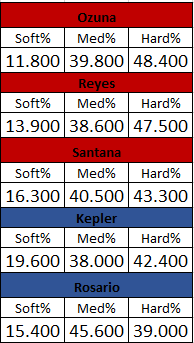
As the table shows, Ozuna had the highest hard-hit rate of any players mentioned earlier. His hard-hit percentage was also better than 96% of other players, so why did he have his arguably worst year at the plate? Bad luck.
Ozuna finished 2019 with a .257 BABIP, suggesting that his batting average of .241 does not accurately reflect the bat to ball skills he possesses. Taking a look at Ozuna’s xBA for 2019 is sitting at .288, a .47 point difference from his actual production. At times, hitters who hit the ball really hard but seem to lack results can tend to drive the ball into the ground too often, cratering their BABIP in some years. This was not the case for Ozuna. In 2019, Ozuna actually decreased is ground ball percentage by six percent. In an inversely correlated move, his line drive rate increased by a little over five percent, further supporting the notion that Ozuna was a bit unlucky last year. To top it all off, after signing a one-year-deal with the Braves, he will now be batting in the middle of one of the most dangerous line ups in baseball and has the potential to be a top 50 fantasy player. Ozuna’s current ADP is similar to that of Eddie Rosario’s, but given the information above, it seems clear that Rosario’s production can be similarly replicated at a cheaper price. Only time will tell, but Eddie Rosario might be overvalued in 2020.
 The Baseball Effect
Leave a comment